Legal concerns prevent Hays County action on water conservation efforts
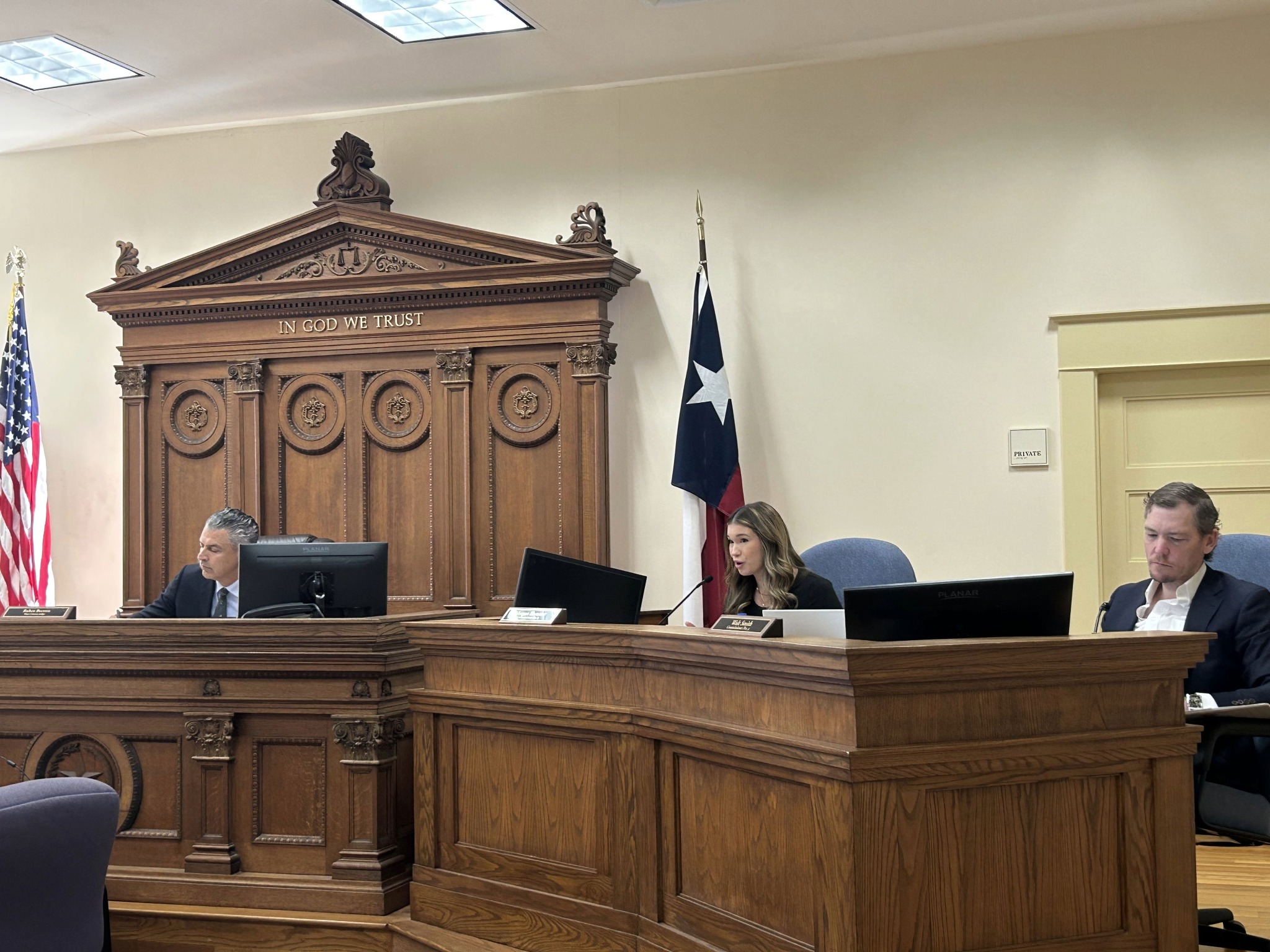
The Hays County Commissioners Court did not take action on three agenda items regarding a resolution brought forth by Judge Ruben Becerra. In his capacity as Director of Emergency Management, Judge Becerra cited Governor Greg Abbott’s Drought Disaster Proclamation and proposed a resolution focused on high volume water restrictions to the court.
The resolution included a temporary evaluation period of 30 days on industrial permit applications and a pause on industrial development requiring more than 20,000 gallons of water per day.
All commissioners agreed with the water conservation basis of the resolution, but were wary to vote on it due to legal concerns and said they did not have sufficient time to thoroughly read through the resolution.
This comes as San Marcos City Council denied rezoning for a proposed data center site on Francis Harris Lane valued at $1.5 billion. Many residents have raised concerns about the water demand and power generation of large-scale AI data centers and booming industry.
Commissioner Debbie Gonzales Ingalsbe said she stood with constituents advocating for the resolution, but questioned if it could be adopted since county officials do not have authority to issue moratoriums, or temporary suspensions, on development. She confirmed with Jim Allison, legal counsel for County Judges and Commissioners of Texas, that the county could not pursue the ordinance.
Becerra heavily pushed for urgency from staff and commissioners to help find creative ways the resolution could be passed. The feedback given by the District Attorney’s Civil Division was that the temporary pause included in the resolution had no legal difference from a moratorium.
“I appreciate the caution…because we move as a group, this court,” he said. “But the way things are written cannot be the way we move on, because we will be standing in front of a Mack Truck if we do not do something.”
Commissioners pointed to Texas legislators as the final say for more authority over land use and development.
“We do need to work with our legislators,” Ingalsbe said. “They can give us this authority that we have been asking for years and years.”
Rep. Erin Zwiener, HD 45–who has pushed for legislation to give counties the power to enact water restrictions–emailed commissioners a letter saying that if Hays County denies development permits without clear authority, they can be open to litigation.
Commissioner Morgan Hammer said the county only has two options for regulating land use.
“These are things we want to do as county’s, we want to be able to control what goes on,” she said. “For land use…we can help dictate where adult businesses go and landfills. That’s it and that’s frustrating,” she said.
Recently, Sen. Paul Bettencourt(R) addressed a letter to Attorney General Ken Paxton to investigate counties proposing moratoria on large-scale development on the basis of H.B. 2559. The letter was in relation to Hood County’s attempt to issue a moratorium on data center development.
Commissioner Walt Smith said that water conservation concerns include groundwater pumping. He said AquaTexas and Dripping Springs Water Supply Corporation have severely overpumped groundwater, resulting in wells drying up.
Texas governance often follows “the rule of capture” which allows land owners to pump unlimited amounts of water on their property. This can often raise conflicts about depletion of nearby aquifers and other water resources.
“I fully support a moratorium on data centers, that being said I’m also a private property rights guy,” Smith said.
“If [water] is coming from the ground [we] need a really strong groundwater district and we need one that’s fully funded and supported that can enforce the rules and the permits that they issue. We don’t have that right now.”
He proposed that the resolution be amended to include a funding mechanism for a groundwater conservation district to review development permits before they are automatically approved within 30 days.
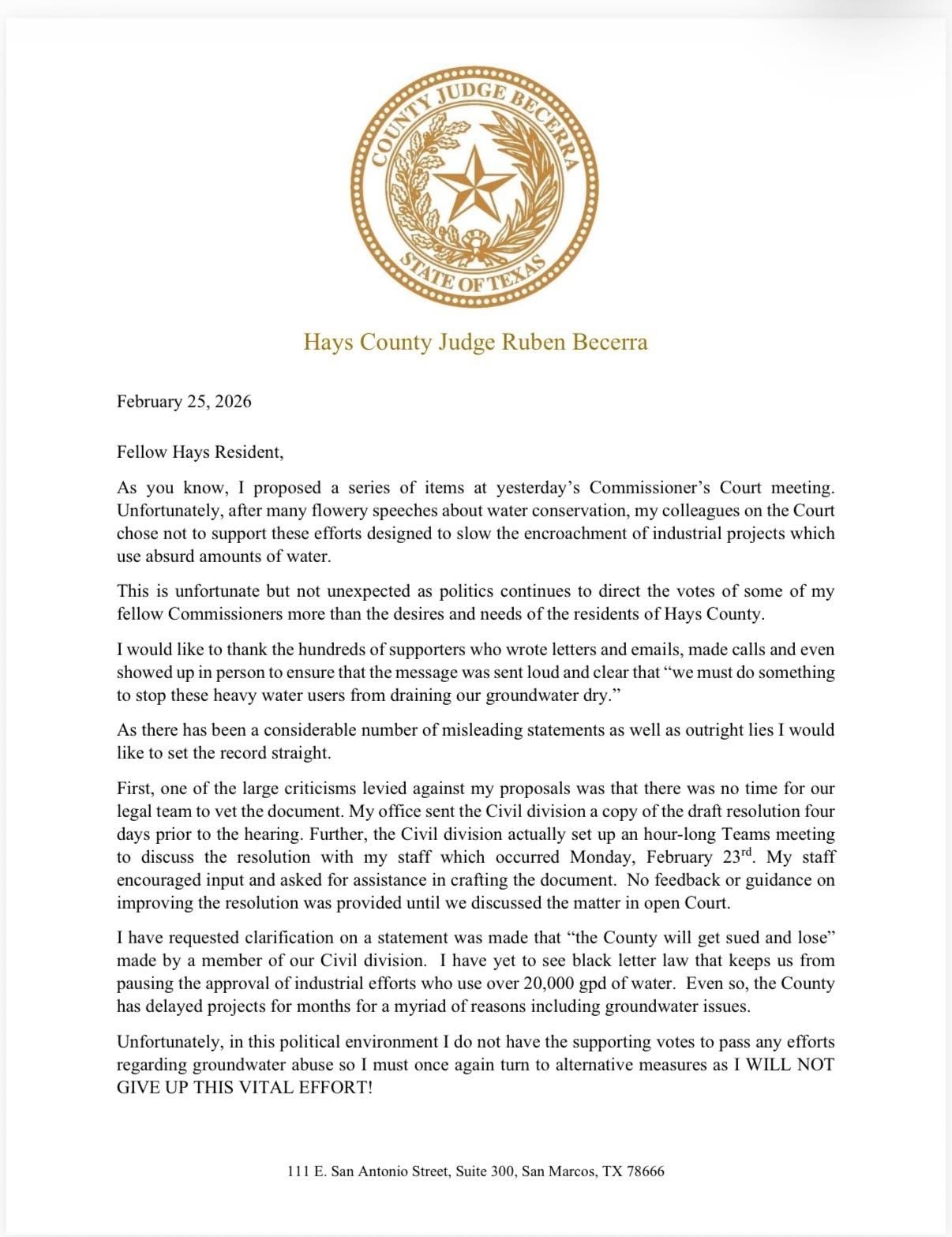
Becerra decided to table the resolution and announced he is working on a “clear water summit” to meet with groundwater districts and providers. He said he is also working with state officials to ask Gov. Abbott to call an emergency legislative session to address local government code and county authority regarding water conservation.
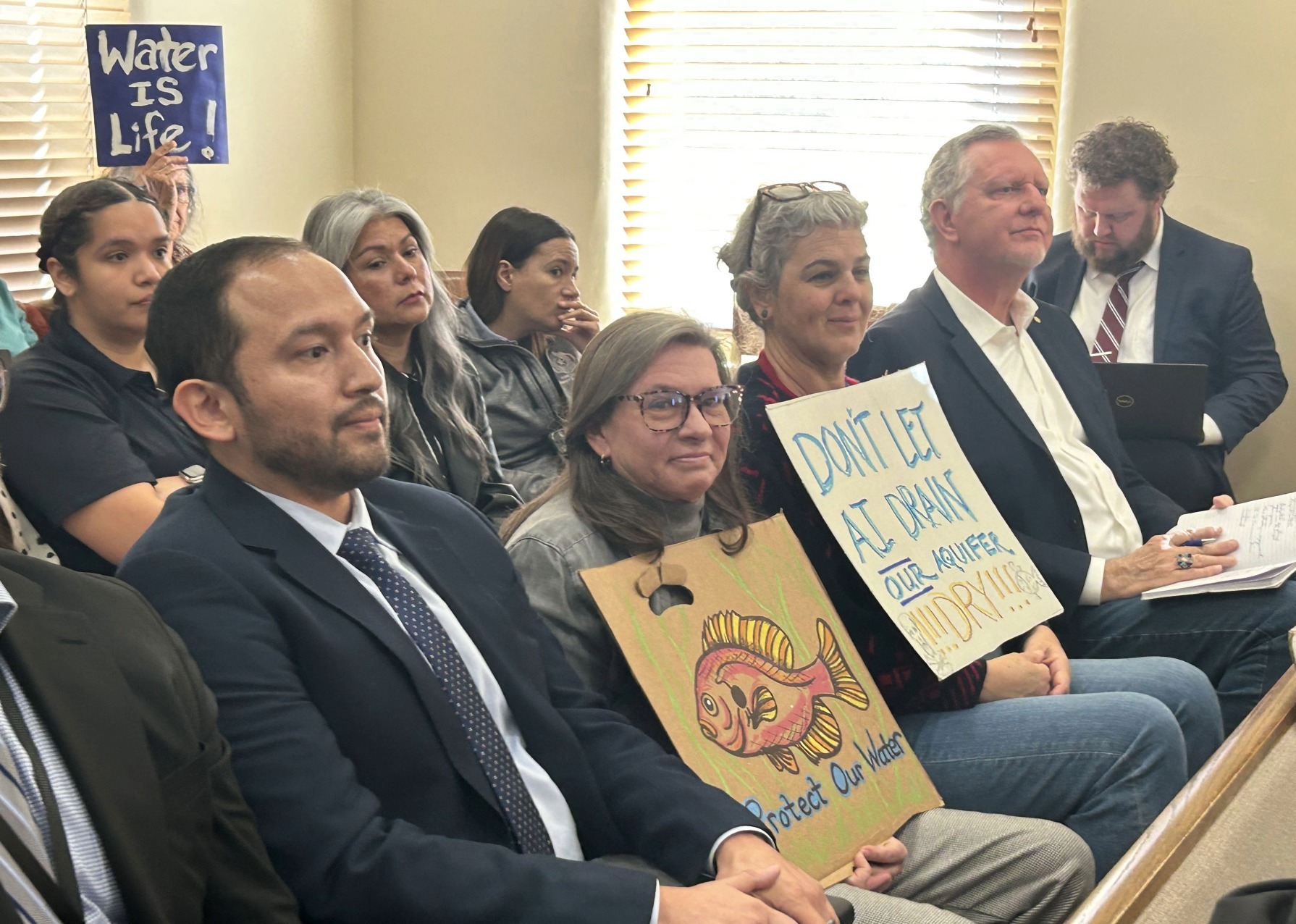
Zane Porterfield, a representative with the Wimberly Valley Watershed Association, said she hopes to see more regional collaboration and better communication within the commissioners court.
“It felt perhaps the judge was operating in a silo without really talking with local experts, other commissioners…” she said. “[It] definitely seems there needs to be more regional collaboration around these issues.”
Epiphany Hodge, a Martindale resident, echoed this sentiment saying that the commissioners weren’t seeing eye to eye.
“We do need to work and collaborate together because this issue of groundwater and protecting our natural finite resource of water has been a longstanding issue and it’s not going anywhere,” Hodge said.
Gina Fleming has attended several San Marcos City Council meetings in the past year related to data center development. She said water conservation is a key nonpartisan issue.
“We need to get rid of these artificial separations and these artificial divisions, and start focusing on what’s important,” Fleming said. “I do see that we can use this as an opportunity to come together at a grassroots level and weave a different society.”
Becerra and local residents are now calling on Crystal Clear Special Utility District to enact Stage 4 drought restrictions at the board meeting Thursday, Feb. 26. This action would halt all large industrial permits in the City of San Marcos.
Post a comment